
The New Rules of Digital Marketing in the Age of AI Agents: Taste, Friction, and the Death of Average
 By fengcainiaoMarch 18, 20265 min read
The AI wave of 2026 is not just an upgrade. It is a regime change.
When we talk about how AI is reshaping digital marketing and SEO, most people zoom in on the obvious: ChatGPT summaries eating organic clicks, AI Overviews pushing down ranked results, SERP real estate shrinking. These are real. But they are surface-level symptoms of something far more structural — a full reset of what the game is even about.
───
I. The Search Engine Is Dead. Long Live the AI Answer Engine.
The biggest shift is this: the unit of competition has changed.
Traditional SEO was about ranking — getting your page to position one, capturing a click, owning that 30% CTR bump at the top of a SERP. The optimization target was an algorithm. You learned its preferences, you engineered your content to satisfy them, you watched a number go up.
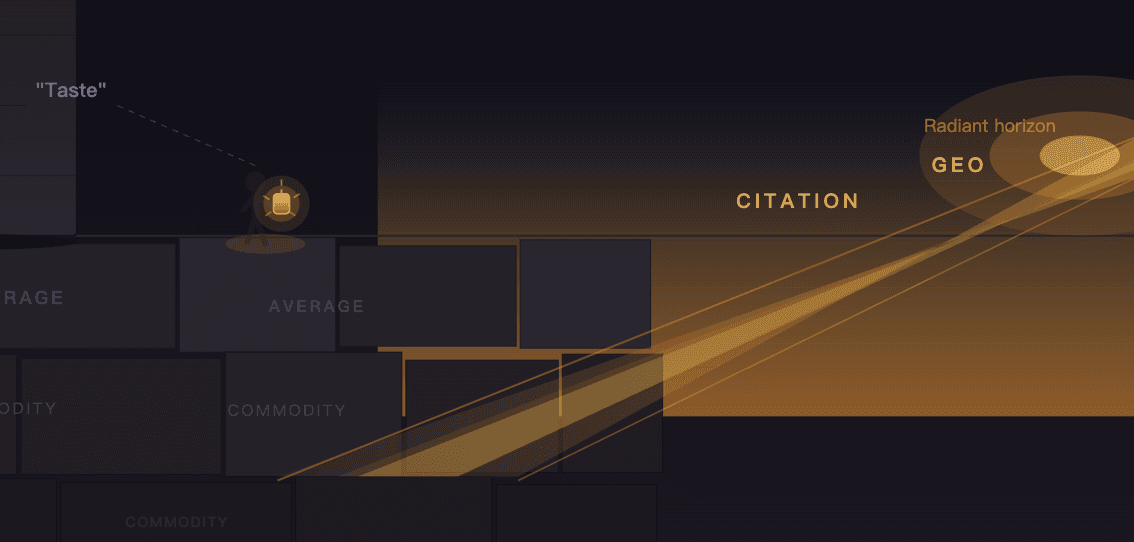
GEO — Generative Engine Optimization — plays by completely different rules. The new target is not a ranking slot. It is consensus. When a user asks Claude or Perplexity or SearchGPT a question, what determines whether your brand or content gets cited? It is not keyword density. It is whether your content has become part of the AI model’s conceptual understanding of the space.
This distinction matters enormously. In traditional SEO, you can reverse-engineer your way to visibility with enough technical precision. In GEO, you cannot. The models pull from sources they have internalized as authoritative — sources that demonstrated genuine expertise, original insight, and structural clarity over time.
The implication for marketers is uncomfortable: there is no shortcut. The content that gets cited by AI engines is exactly the content that would have impressed a smart, skeptical human editor. First-hand experience, specific examples, non-obvious conclusions. If your content is AI-generated average, AI will filter you out. Because it has already consumed the same average.
───
II. Taste Is Now a Business Metric
The AI companies at the frontier keep talking about “taste.” It sounds like a soft concept. It is not.
Here is the definition that actually holds up: taste is the ability to identify the right 1% from an infinite field of average.
AI can generate 1,000 blog posts, 1,000 product descriptions, 1,000 brand strategies. What it generates by default is the aggregate of all human creative output — which means its default output is, by definition, average. The average of everything is nothing distinctive.
The company with taste knows which one of those 1,000 options lands — and why. That judgment cannot be automated. It is a competitive moat.
For AI entrepreneurs, taste shows up in three ways:
The Curator’s Eye — choosing the most precise option from an overwhelming field, not by preference, but by strategic compression.
Obsession with Simplicity — the willingness to remove features that work but don’t belong. The best AI-native products don’t layer chatbots onto existing workflows. They rebuild the workflow around a simpler core interaction.
Strategic Refusal — in the AI era, feature creep is trivially easy. Companies without taste say yes to everything that looks impressive. Companies with taste say no to 90% of it — because they know it would compromise the thing they are actually building toward.
For marketers, taste is the shift from amplifier to filter. When AI can produce unlimited content volume at near-zero cost, the scarcest resource is curation. Brand identity in the AI era is not constructed by addition. It is constructed by subtraction.
───
III. Friction Is the Hardest Metric to See — and the Most Important
Friction is everything that exists between a user’s intent and their goal.
It is not just slow load times or confusing navigation. Friction is cognitive. It is the moment a user has to stop and think: what is this asking me to do? It is the emotion-breaking popup that appears when someone is ready to buy. It is the SEO content that ranks for a keyword but does not match the actual intent of the person who searched it.
Three lenses for measuring friction:
Cognitive Load — how much mental effort does the user have to invest before they get value? Every step of reasoning you ask a user to perform is a step toward abandonment.
Time to Value — how many actions stand between the user arriving and experiencing the product’s core benefit? The best AI-native products collapse this to near zero.
Emotional Damping — does the interaction break the user’s emotional momentum? This is the subtlest form of friction — and the most damaging for brand perception.
The critical nuance is that not all friction is bad. Intentional friction is a design tool. The confirmation dialog before an irreversible action. The layered packaging of a premium product that turns opening it into a ritual. Taste is knowing the difference between friction that protects and friction that destroys.
───
The Synthesis: What You’re Actually Competing On
In 2026, execution is a commodity. AI can draft, generate, optimize, A/B test, and iterate at machine speed. The execution layer is available to everyone.
The only non-commoditized layer is judgment. What to build. What to say. What to cut. What to keep. How to recognize the difference between a product that works and a product that matters.
That judgment — expressed as taste in design, felt as friction reduction in experience, applied as curation in content strategy — is the only real competitive surface left.
For marketers and operators building in this environment, the question is not how do I use AI tools better? The answer to that question is available to everyone.
The question is: what do I know, believe, and perceive that the average operator does not?
That is the gap that actually compounds.